








Private 5G Network
Companies today rely heavily on high-quality communication. Many have used Wi-Fi networks for years, but the future points towards a more powerful alternative: private 5G networks.
Private networks offer organizations greater control, reliable connectivity, and robust security. But what exactly is a private 5G network, and how can enterprises benefit?
This article explains what a private network is, how it compares to traditional solutions like Wi-Fi or public networks, and why organizations should consider adopting private 5G technology.
What is a Private 5G Network?
A private 5G network is a self-contained cellular network used exclusively by one organization.
Unlike a shared public network, the organization owns and manages all the equipment. It provides greater control and ensures secure connectivity, customized to the organization's specific requirements.
Key Differences Between Private 5G Networks and Wi-Fi
Understanding the key differences between private wireless networks and traditional Wi-Fi helps clarify why private 5G is becoming increasingly popular.
Coverage and Mobility
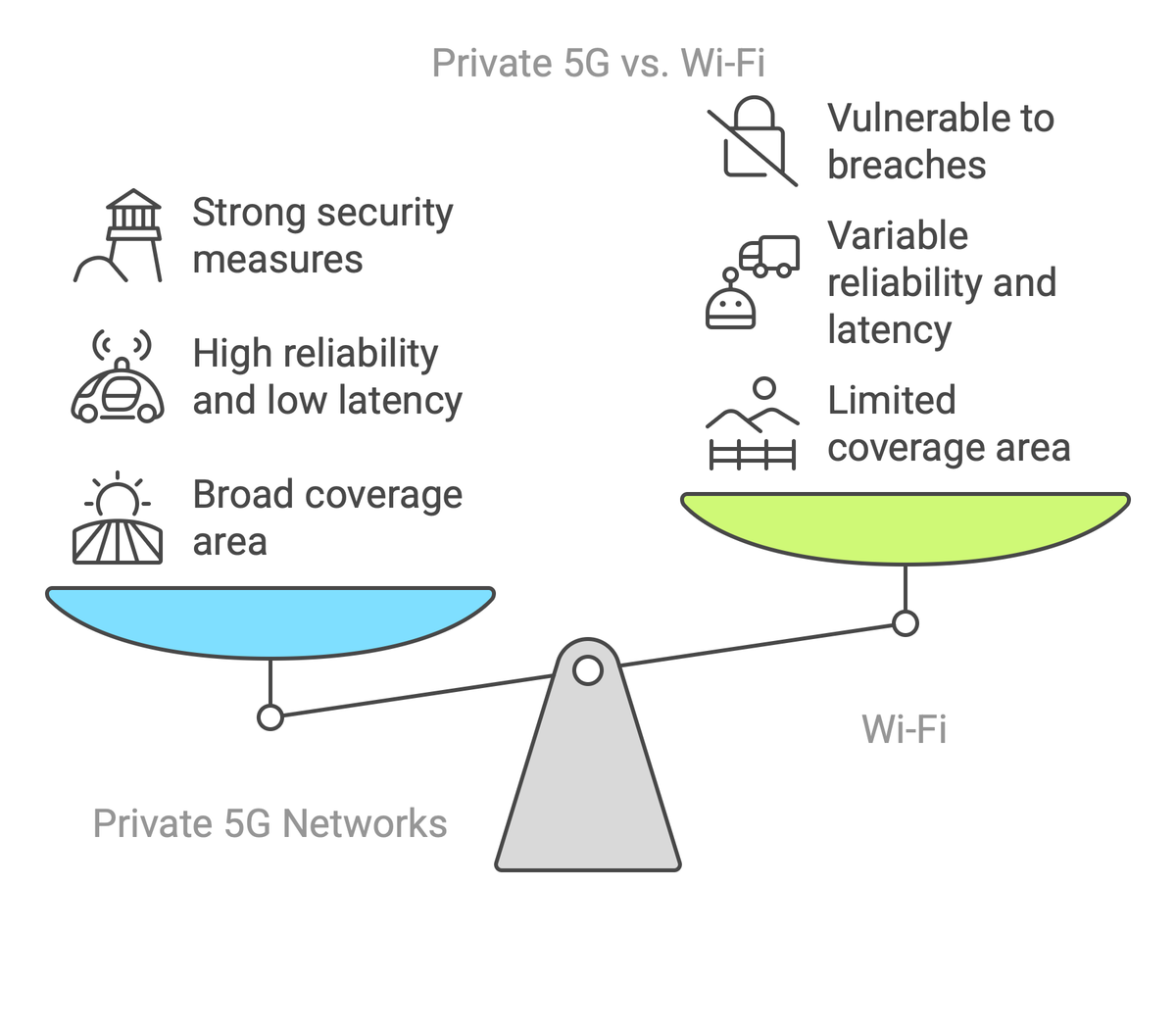
Wi-Fi typically covers limited areas, often requiring multiple access points to maintain connectivity. On the other hand, private cellular networks offer broader coverage, reducing the need for extensive infrastructure. This makes them ideal for large industrial facilities, warehouses, or campuses.
Reliability and Latency
Private 5G provides highly reliable connections with lower latency compared to Wi-Fi. In manufacturing scenarios where autonomous guided vehicles and robotics need dependable and fast communication, private 5G networks can fully support operations without interruption.
Security and Access Control
Wi-Fi is convenient but often vulnerable to unauthorized entry, risking sensitive data and intellectual property. A private 5G network provides robust security through stronger encryption standards and advanced access control, permitting organizations to provide restricted access only to verified end user devices.
Bandwidth and Speed
Private 5 G networks feature high bandwidth and faster speeds, which are especially beneficial when handling large data volumes, such as augmented reality applications or real-time video streaming. Wi-Fi, especially in crowded environments, often experiences slowdowns due to interference and congestion.
How Private 5G Networks Operate
Private 5G networks utilize cellular technology designed specifically for private use. An organization can deploy such a network in different ways, using licensed or unlicensed spectrum or even shared spectrum.
Spectrum Usage Types
- Licensed Spectrum: Organizations can lease spectrum directly from governments or telecom regulators to ensure exclusive rights.
- Shared Spectrum: Certain bands of spectrum are available for shared use, allowing multiple organizations to operate simultaneously without interference.
- Unlicensed Spectrum: Similar to Wi-Fi, organizations can use unlicensed spectrum bands, although this may result in interference and reduced performance.
Advantages of Using Private 5G Networks
Private mobile network technology provides multiple benefits to businesses, making it a preferred choice across various industries.
Enhanced Security
Private LTE and 5G networks offer stronger encryption and advanced access control mechanisms. Organizations gain peace of mind, knowing that sensitive data stays secure and within internal control.
Improved Performance
With lower latency and enhanced reliability, private networks support critical business applications smoothly. Tasks involving real-time data analysis like predictive maintenance, remote monitoring, and automation benefit greatly.
Higher Capacity and Scalability
As enterprises add more devices, traditional networks can become congested. Private 5G networks easily handle increased numbers of connected devices without compromising performance, ensuring scalability.
Reduced Downtime
Reliable connectivity means less downtime and fewer interruptions to business processes. High reliability ensures operational continuity even in demanding environments.
Full Control and Customization
A wholly owned private 5G network gives enterprises more control over network slicing, quality of service, and the deployment of innovative solutions to meet specific business requirements.
Greater Mobility and Flexibility
Private wireless networks offer seamless mobility for end-user devices. Employees can move freely throughout facilities without losing connectivity, enabling greater flexibility and efficiency.
Practical Applications of Private 5G Networks
1. Manufacturing and Industry 4.0
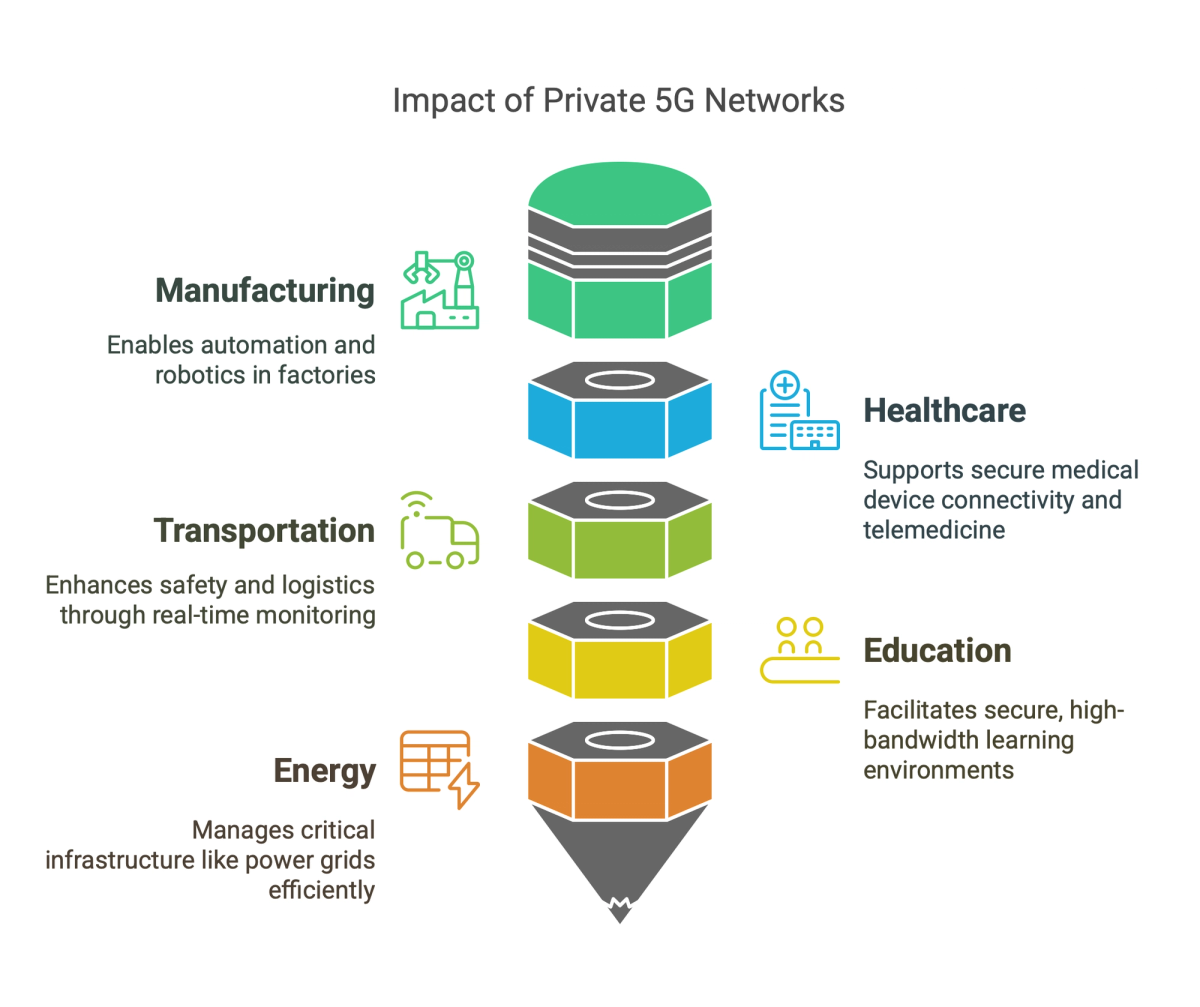
Manufacturing plants use private 5G networks to enable automation, robotics, and autonomous guided vehicles. Manufacturers streamline operations and improve productivity with faster speeds, lower latency, and high reliability.
2. Healthcare and Telemedicine
In healthcare, private cellular networks help hospitals securely connect medical devices, manage patient information accurately, and support telemedicine applications.
3. Transportation and Logistics
Real-time monitoring and predictive maintenance systems enabled by private 5G improve safety, reduce downtime, and optimize vehicle routes and logistical operations.
4. Education and Smart Campuses
Educational institutions deploy private networks for secure, campus-wide coverage. High bandwidth capabilities support augmented reality learning tools and interactive educational experiences.
5. Energy and Utilities
Utilities use private networks to securely manage critical infrastructure such as power grids, pipelines, and smart metering, ensuring continuous service and improved efficiency.
Creating a Private 5G Network: All the Equipment Needed
To successfully deploy and manage a private 5G network, organizations require several key components:
- Core Network Equipment: Essential for data routing, policy enforcement, and user management.
- Radio Access Network (RAN): Includes base stations and antennas, which are crucial for connecting devices wirelessly.
- Edge Computing Infrastructure: Provides quick local data processing, reducing latency for critical applications.
- Connected Devices: Smartphones, IoT sensors, autonomous vehicles, and other specialized equipment.
- Security and Access Control Solutions: Ensure network protection through robust security mechanisms.
Depending on their in-house capabilities, organizations can either host parts of their private networks internally or outsource management to specialized providers.
Challenges to Consider
While benefits are considerable, some challenges exist:
- Cost Considerations: Initial investments for equipment and spectrum licensing can be substantial.
- Technical Expertise: Organizations may need specialized knowledge to effectively manage networks internally.
- Regulatory Issues: Spectrum licensing regulations vary by region, potentially complicating deployments.
Future of Private 5G Networks
Modern enterprises require advanced connectivity solutions like private 5G. As technology advances, capabilities and applications will grow even broader, driving innovation and industry transformation.
In the future, private 5G networks will support an even wider range of innovations, such as advanced robotics, artificial intelligence integration, real-time analytics for operational efficiency, and broader adoption of augmented reality.
Why Should Organizations Consider Private 5G?
Private 5G networks not only provide robust security and reliable connectivity but also deliver faster speeds, higher capacity, and greater flexibility compared to traditional Wi-Fi or public network options.
Organizations benefit significantly from having full control over their communications infrastructure, resulting in increased efficiency, improved safety, and higher productivity.
Conclusion
Private 5G networks represent the next step forward in enterprise connectivity. Private mobile networks offer greater control, reliability, security, and innovation than traditional methods and provide a powerful foundation for digital transformation across industries.
As connected devices increase and operational demands grow, adopting a private 5G infrastructure becomes increasingly crucial.
Ready to explore how a private 5G network can transform your organization?
About the authors

Sina Khanifar is the CEO of RSRF and Waveform, with nearly two decades of experience in in-building wireless connectivity. He holds a BA in Physics from the University of Oxford and is also a Technology Fellow at the Electronic Frontier Foundation, co-founder and advisor to OpenSignal.com, and a Board Member of the Repair Association.
About RSRF
RSRF is Waveform's enterprise division. Our nationwide team of installers can deploy cellular DAS, Private 5G, and Public Safety/ERRCS DAS anywhere in the US. Learn more about RSRF