The same walls that keep rooms quiet keep signal out.
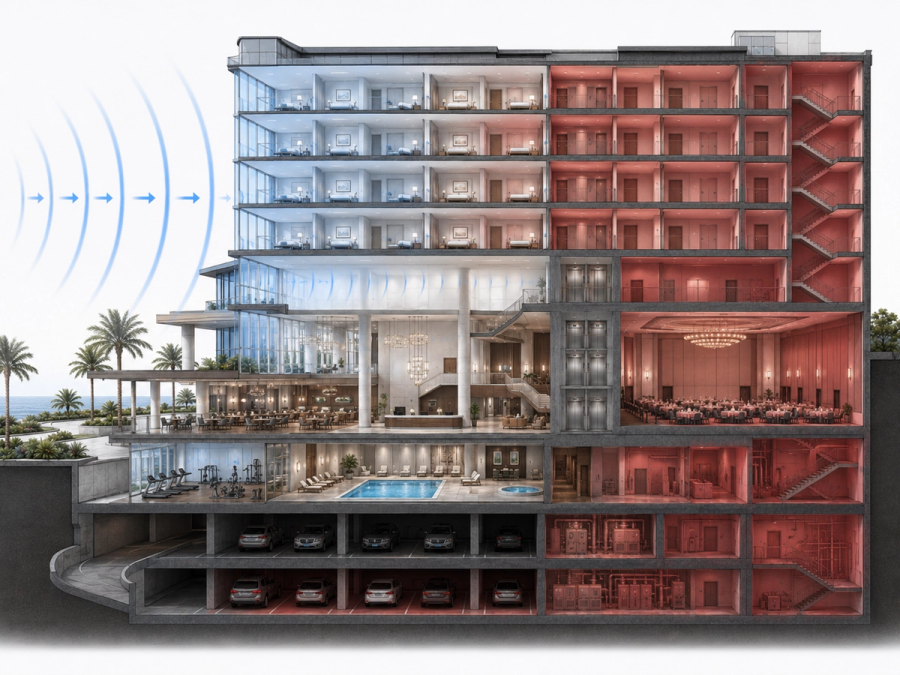
The features that define a good hotel stay are the ones that block cellular signal. Concrete between floors leaves mid-building guest rooms with nothing, and the ballroom, where guests gather in the highest numbers, is usually the worst coverage in the building.
Guests who cannot get signal in their room write it into a review, and that review ranks in search next to your property listing. Event planners ask about cellular coverage during site selection now, the same way they ask about AV and catering, and a corporate group that cannot make calls from your ballroom does not book a second event.
RSRF has deployed DAS in full-service hotels, luxury resorts, convention centers and historic hotel buildings with complex masonry, installed around occupied floors and live events. We've done it before.
What we get called in to fix
Interior corridor dead zones
Hallways without exterior exposure receive no usable signal from the outdoor macro network.
Ballroom and event space gaps
Large gathering spaces are the highest-traffic, lowest-coverage areas in most hotels.
Below-grade amenity coverage
Fitness centers, spas, pool areas, and parking garages have no path for outdoor signal to reach them.
Concrete construction attenuation
Multi-story hotel construction blocks vertical and lateral signal propagation between guest floors.
Occupied property installation
Work must be coordinated around active guests, events, and hotel operations without disruption.
All-carrier guest expectations
Guests on every carrier expect the same reliable experience throughout the property.
It depends on the size of the property, how it is built, and whether the design can work off air from a nearby cell tower or needs a carrier signal source. Guest floors are repetitive and predictable. Ballrooms, spas, and below-grade parking are not, and they are what moves the number. After the site survey we give you a budgetary estimate, and it is usually accurate to within 10% of final pricing.
Who looks after the system once it is live?
We do. The system is monitored remotely and the ongoing maintenance sits with us, so a fault is usually identified before a guest complains about it. When you add a wing or bring on another carrier, the same team extends the system rather than handing you to another DAS provider.
What is a distributed antenna system, and why would a hotel need one?
A distributed antenna system takes one cellular signal source and spreads it through a building across multiple antennas, so indoor coverage is even on every floor instead of concentrated near the windows. Hotels need one because the signal has to reach interior corridors, ballrooms, spas, and below-grade parking that cell towers outside the building cannot serve on their own.
Can you install in an occupied hotel without disrupting guests or scheduled events?
Yes. Hotels never fully go offline, so we schedule around your calendar instead of asking you to clear it. Our teams work with the front desk, facilities, and events staff to move floor by floor, avoid peak occupancy periods, and stay clear of guest-facing areas while events are running. Corridors, above-ceiling runs, and back-of-house spaces are staged so that no guest interaction is required and no revenue-generating space is taken offline.
How do you design coverage for ballrooms and event spaces with variable occupancy?
A ballroom holding 800 people for a general session puts far more demand on the network than the same room empty, so guestroom design rules do not transfer. We design for peak capacity rather than average use. Antenna placement and signal levels are modeled for large open spans, high ceilings, and the loading patterns of event-driven space.
Who handles the carrier coordination and signal source approval process?
That work is ours, start to finish. We submit the applications, work each carrier's approval process, and prove the installed system meets their technical specifications before sign-off. You do not need a direct relationship with any carrier to get this done.
Can the system be expanded when we add a new wing, tower, or amenity building?
Yes, and we design for it upfront. A new wing, tower, pool building, or spa can be added to the existing DAS infrastructure without rebuilding the core system: extend the cable plant, add remote units. That is significantly more cost-effective than a standalone deployment for each new structure.
How long does a hotel DAS installation take?
Most hotel projects run 8 to 15 weeks from site survey to a live system. That breaks down as 1 to 3 weeks for system design and the on-site visit, 1 to 3 weeks for the final proposal, and 3 to 6 weeks for deployment once approved. For phased properties or multi-building campuses, we sequence the work to minimize impact on operations throughout.
Can the system support both cellular guest coverage and a private staff radio or push-to-talk network?
Yes. The same DAS infrastructure can carry commercial carrier signals for guests and a private staff radio or push-to-talk network at the same time. Security, housekeeping, maintenance, and events staff get reliable in-building radio coverage, and we design for both use cases from the start so you are not running two separate systems.
Can we use coverage documentation in our event sales and marketing materials?
Yes. Every project includes a signal audit report with before-and-after coverage maps showing measured signal strength throughout the property. Event planners, meeting bookers, and corporate clients ask about connectivity, and being able to show verified coverage across your ballrooms, guestrooms, and common areas is a real differentiator when a booking is close.
Ready to fix cellular coverage in your building?
Schedule a free 30-minute call with an RSRF DAS specialist. We'll talk through your building, coverage challenges, carrier requirements, and the most practical options for improving service.
Understand which DAS technology fits your building
Get a realistic budget and timeline
Leave with clear next steps—no commitment required
 [email protected]
 (800) 637-4049